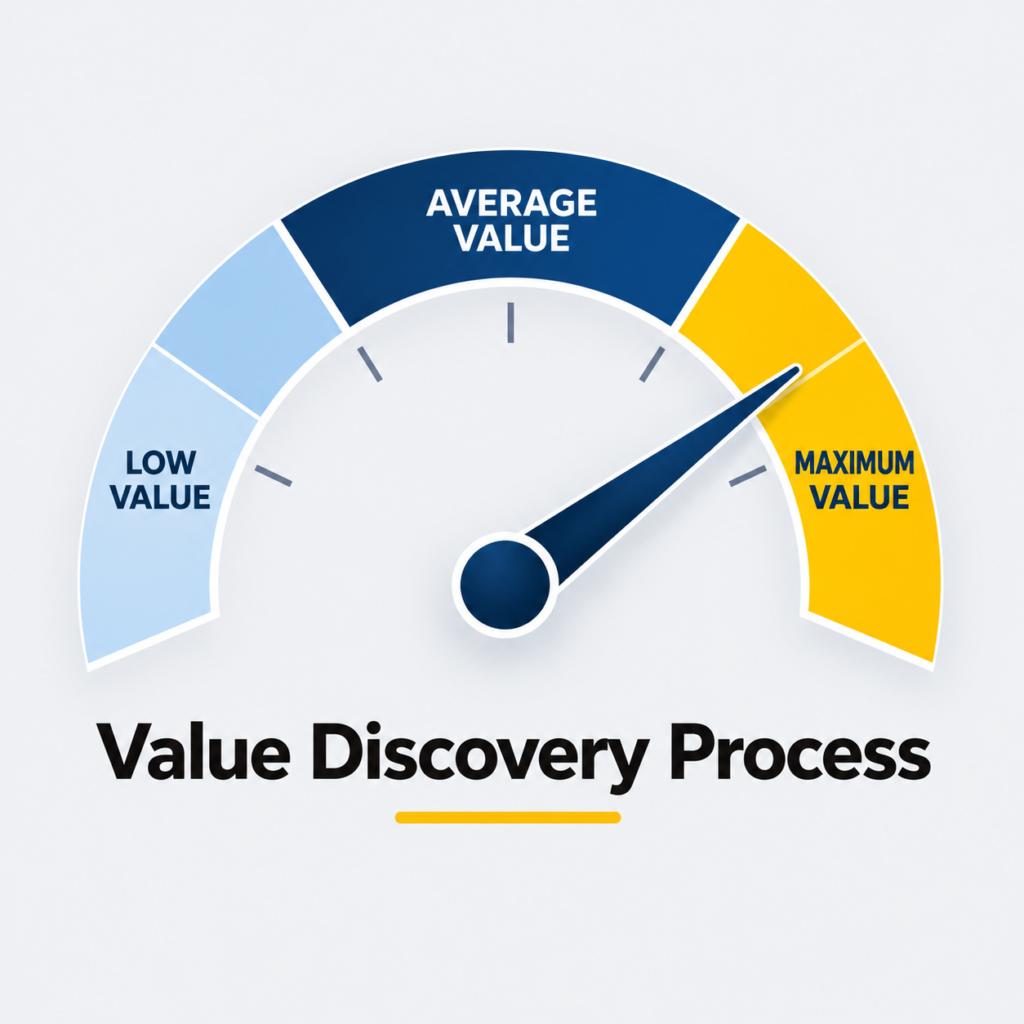
A free, confidential business valuation that reveals what buyers may pay, what drives your company’s value, and where opportunities exist to maximize your sale price — before you commit to selling.
Most owners think that timing the market will help their value.
In actuality, their value is determined by how well prepared they are.
Value is determined by preparation, positioning, and the risk profile of the business before buyers begin their analysis. The Value Discovery process is our structured framework to help you build value, reduce risk, and keep leverage on your side.
Long Before Market
Value is Established.
Clean books and reports, standardize procedures, reduce owner dependency. These are the levers that justify a premium valuation.
At Market
Value is Proven.
During diligence, buyers will ensure the accuracy of your reports and any misalignment could result in a discount, re-trade, or worse… a dead deal.
What is my business worth?
Buyers pay for cash flow — and the quality of that cash flow.
This is one of the most common misconceptions about business value. Revenue matters, but it doesn’t determine what your business is worth. Buyers focus on the cash flow your business generates — and how predictable, sustainable, and transferable those earnings are.
✕
The myth
“The business does about $10M in revenue, that should be close to market price.”
The revenue may be attractive, however, profit creates value. A high-revenue business with thin margins, one major customer, and an involved owner is often worth far less than its top line suggests. Buyers pay for sustainable, predictable cash flow—not revenue alone.
✓
The reality
Value = Cash Flow × The Multiple.
Buyers pay higher multiples for earnings they believe will continue after the owner leaves. Greater risk lowers the multiple—and the value
common terms in plain-english
Cash Flow (SDE / EBITDA)
The true earnings of the business after normalizing financials with appropriate add-backs. This is the foundation buyers use to determine value.
The Multiple
The number applied to your cash flow to determine value. It’s driven by risk profile, consistency, and transferability.
Working - Capital Peg
The agreed-upon amount of working capital the business must have at closing so it can continue operating normally.
Seller Carry Note
Part of the purchase price financed by the seller and repaid by the buyer over time, usually with interest. Common, and must be structured carefully.
The Value Discovery Process
A proven 5 stage framework from initial conversation to successful sale.
Each stage is designed to increase value and protect the sale outcome. Skipping stages doesn’t save time, it costs money.
1
Stage 01 — Analysis
A disciplined assessment of readiness
through the eyes of a buyer — to surface gaps, risks and friction points that move the valuation.
Financial clarity
Operational risk
Owner dependency
Concentration risk
Diligence readiness
Outcome
A clear understanding of what will help — or hurt — your value in a sale.
02
Stage 02 — Planning
Determine what buyers actually value.
Not every improvement matters equally. We build a prioritized plan that rewards the specific value drivers that buyers pay for — and neutralizes the risks they penalize.
Strengthen value drivers
Reduce perceived risk
Increase scalability
Prioritize by EBITDA impact
Outcome
A practical roadmap that improves value without unnecessary complexity.
03
Stage 03 — Strengthen
Turn performance into a defensible story.
Valuation isn’t just math — it’s interpretation. We align your numbers with a credible narrative buyers can understand, trust, and justify, backed by evidence rather than optimism.
Defensible framework
Right metrics
Buyer-relevant framing
Evidence over optimism
Outcome
A valuation and narrative that withstands diligence and negotiation.
04
Stage 04 — Market Preparation & Buyer Strategy
Confidential Marketing
A controlled, strategic go-to-market plan that attracts the right buyers.
Buyer targeting
Confidential prep
Information structuring
Protect leverage
Outcome
A controlled, strategic go-to-market that attracts the right buyers.
05
Stage 05 — Deal Execution & Close
Protect value through the finish line.
Most deals lose value during diligence, not for lack of interest, but due to poor deal execution. We manage with a disciplined process so the value you built earlier isn’t given back at the table.
Offer & structure
LOI negotiation
Diligence coordination
Close with certainty
Outcome
A transaction that reflects true value — not last-minute concessions.
Skipping stages doesn't save time. It costs money.
What pushes the multiple up — and what drags it down.
Two businesses with the same revenue and profit can sell for dramatically different prices. Buyers don’t just evaluate what a business earns today—they evaluate the quality, predictability, and transferability of those earnings.
Pushes it up
Recurring Revenue: Long-term service agreements and predictable customer relationships.
Revenue weighted to service over one-off projects
Management Depth: A business that operates successfully without the owner being there.
Customer Diversification: A broad customer base without overreliance on one account.
Clean Financials & Systems: Accurate reporting, documenting processes, and organizing records
Drags it down
Owner Dependency: The owner is the primary salesperson, estimator, operator, or relationship holder
Customer Concentration: A significant portion of revenue depends on one or two customers
Unpredictable Revenue: Heavy reliance on project-based work with inconsistent performance
Financial Uncertainty: Commingled personal expenses, inconsistent reporting, or incomplete records
Who we help
Which owner are you?
However you got here, it starts the same way – with your number. Find yourself below, and see what Value Discovery does for you specifically.
Most common
The retiring owner
60s–70s, built it over decades, ready to turn a lifetime of work into liquid wealth – often with no obvious successor.
→
Confidence in the best possible price, and a clear process so you’re never lost.
2nd most common
The owner planning ahead
Knows they want out in one to three years and wants to do it right – not leave money on the table.
→
A roadmap to raise value before market – books, owner-dependency, concentration.
3rd most common
The owner with an offer on the table
A competitor, supplier, or PE buyer approached directly – and it’s flattering. The “I’ve got this handled” trap.
→
What you’d leave on the table going solo – and protection against a professional buyer.
The "what's it worth" owner
Not committed to selling – just wants a number. Curious after a competitor sold, or after some back-of-the-napkin math.
→
A credible, defensible valuation – in plain English, no obligation.
Passing it to family or employees
Wants to keep it in the family or reward a loyal crew – an internal handoff that preserves legacy and relationships.
→
A transfer that pays you out and keeps relationships intact, with financing options for the buyer.
The owner who needs to sell
A trigger put a clock on the sale – burnout, a health scare, a relocation, a key employee leaving.
→
Moving with discretion and speed, backed by a real buyer network – without giving the business away.
What you get
A free valuation, and an honest review of your business.
Every engagement begins with a free, confidential business valuation and analysis. Understand what your business is worth, how buyers will evaluate it, and what could increase its value — before making any commitments.