How to Sell a Pest Control Business: Valuation, Buyers & Exit Strategy
You’ve spent years building your pest control company.
You’ve developed customer relationships, hired and trained technicians, invested in vehicles and equipment, and built a reputation for delivering dependable service.
But when you’re thinking about retirement, pursuing another opportunity, or reducing your involvement, an important question comes up:
What is my pest control business worth, and how do I sell it for the best possible outcome?
Pest control companies can be attractive acquisition opportunities, particularly when they have recurring service agreements, strong customer retention, efficient service routes, and consistent profitability.
However, not every pest control business is valued equally.
Buyers look beyond annual revenue. They examine the quality of recurring revenue, customer retention, technician productivity, route density, management strength, licensing, and the company’s ability to continue operating after the owner leaves.
Understanding these factors can help you prepare for a sale, establish realistic expectations, and make better decisions about your future.
How Much Is a Pest Control Business Worth?
Most established, profitable pest control businesses are valued primarily on their ability to generate sustainable earnings.
For larger companies, buyers commonly evaluate adjusted EBITDA, or earnings before interest, taxes, depreciation, and amortization, with appropriate adjustments for legitimate nonrecurring expenses and other normalizations.
Smaller owner-operated pest control businesses may instead be evaluated using Seller’s Discretionary Earnings (SDE).
A common valuation formula is:
Enterprise Value = Adjusted EBITDA × Valuation Multiple
Consider a hypothetical pest control company generating $1 million in adjusted EBITDA.
| Illustrative EBITDA Multiple | Enterprise Value |
|---|---|
| 3.0× | $3,000,000 |
| 4.0× | $4,000,000 |
| 5.0× | $5,000,000 |
| 6.0× | $6,000,000 |
These multiples are examples used to illustrate the calculation. They are not current pest control industry benchmarks or estimates of what a particular company would sell for.
The actual valuation depends on several factors, including:
- Recurring service revenue
- Customer retention and cancellation rates
- Profitability and earnings consistency
- Route density and technician productivity
- Customer concentration
- Management strength
- Licensing and regulatory compliance
- Owner involvement
- Growth opportunities and buyer demand
Two pest control companies generating similar earnings can receive substantially different offers.
For example, a company with recurring residential service agreements, strong customer retention, and efficient routes may be valued differently from a business with unpredictable revenue and substantial dependence on its owner.
Buyers aren’t simply purchasing your current earnings. They’re evaluating how reliably those earnings will continue after ownership changes.
For more information, read How Buyers Actually Value a Service Business.
What could your pest control company sell for?
A professional valuation can help establish realistic expectations and identify the characteristics that support or limit your company’s market value.
Get Your Free, Confidential Business Valuation
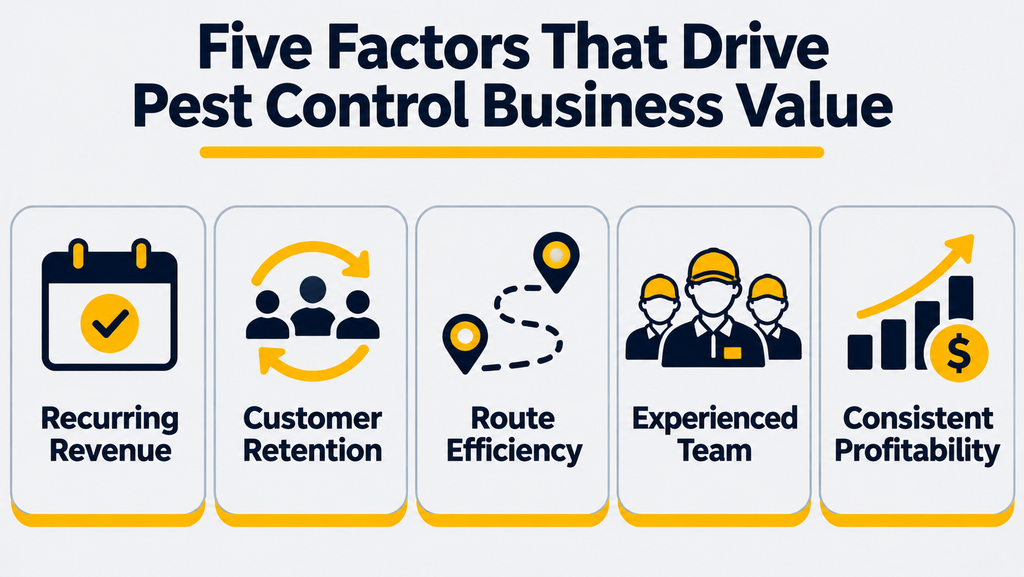
Five Factors That Drive Pest Control Business Value
Several characteristics can significantly influence buyer interest and valuation.
Understanding these value drivers can help you identify opportunities to strengthen the business before selling.
1. Recurring Service Revenue
Recurring revenue is one of the most important characteristics buyers evaluate in pest control companies.
Residential and commercial pest control customers often receive scheduled treatments throughout the year.
These recurring service relationships can create predictable billing and ongoing customer contact.
However, buyers don’t simply count the number of service agreements.
They evaluate:
- Monthly and annual recurring revenue
- Customer retention
- Cancellation rates
- Service frequency
- Revenue per customer
- Contract terms
- Pricing and profitability
- Agreement transferability
A company with substantial recurring revenue may be attractive, but its value depends on how profitable and dependable that revenue actually is.
The strongest recurring revenue is predictable, profitable, and likely to continue after the sale.
2. Customer Retention and Diversification
Customer retention is especially important in pest control.
Acquiring new customers can require meaningful investments in advertising, sales, and technician capacity.
A company that consistently retains its customers may generate more predictable revenue and reduce the cost of replacing canceled accounts.
Buyers may evaluate annual customer retention, cancellation reasons, customer tenure, and the effectiveness of retention programs.
Customer concentration also matters.
For example, a company generating a significant percentage of revenue from one commercial property management group may face greater risk if that relationship ends.
By comparison, a diversified portfolio of recurring residential customers and commercial accounts may provide greater stability.
Buyers generally want confidence that customer relationships will survive the ownership transition.
3. Efficient Routes and Technician Productivity
Pest control is a route-based service business.
That makes operational efficiency especially important.
Technicians spend time traveling between customers, performing treatments, documenting work, and responding to service requests.
A company with geographically concentrated customers may complete more profitable service visits than a competitor covering the same number of accounts across a much larger area.
Buyers often evaluate:
- Route density
- Revenue per technician
- Number of completed service visits
- Travel time
- Scheduling efficiency
- Vehicle utilization
- Service margins
Consider two hypothetical pest control companies generating the same revenue.
Company A operates efficiently within a concentrated service territory.
Company B serves customers scattered across several regions, requiring significant driving time between appointments.
Even with similar revenue, Company A may achieve better operating margins and require fewer resources to maintain its customer base.
Efficient routes can improve profitability and create opportunities for growth without proportionally increasing overhead.
4. Experienced Technicians and Management
A pest control company’s employees are central to its success.
Experienced technicians, service managers, branch managers, and administrative personnel provide capabilities that can take years to develop.
Buyers evaluate employee retention, training, qualifications, licensing, and how much the business depends on individual employees.
They also examine the owner’s responsibilities.
If you’re personally managing scheduling, customer complaints, technician supervision, licensing, and major commercial accounts, a buyer may need additional management personnel or a longer transition.
A company with capable supervisors and established operating procedures may be easier to transfer.
5. Consistent Profitability and Growth Capacity
Buyers ultimately want to understand how much cash flow the business can sustainably generate.
They review revenue trends, gross margins, payroll, vehicle expenses, customer acquisition costs, and adjusted earnings.
They also evaluate whether the company has the capacity to expand.
For example, a business with efficient routes, experienced supervisors, and strong scheduling systems may be able to add customers without substantially increasing overhead.
That capacity can create opportunities for a buyer.
However, growth potential is meaningful only when supported by realistic financial and operational assumptions.
A pest control business with reliable earnings, strong retention, efficient operations, and limited owner dependence may attract greater buyer confidence than a larger but less predictable company.
Understand what drives your pest control company’s value
Our pest control business advisory services help owners evaluate the factors buyers consider and identify opportunities to strengthen their market position.
Explore Our Pest Control Business Valuation & Sale Services
Why Recurring Revenue Matters So Much to Pest Control Buyers
Recurring service revenue is an important feature of many pest control companies.
Unlike a business that must find new projects every month, an established pest control operation may have a large customer base receiving regularly scheduled services.
This can provide greater visibility into future revenue.
But buyers don’t value every recurring customer equally.
Consider two hypothetical pest control companies.
Company A has $5 million in annual revenue, with most sales generated by recurring customers who have remained with the business for several years.
Company B generates the same revenue but depends heavily on one-time treatments and customer acquisition campaigns.
Even if their reported earnings are similar, buyers may have greater confidence in the predictability of Company A’s revenue.
However, recurring revenue alone doesn’t determine value.
A business with high cancellation rates, underpriced accounts, or inefficient routes may still present significant acquisition risk.
Buyers want to understand not only how much revenue recurs, but also how long customers stay and what it costs to serve them.
How Do Customer Retention and Cancellation Rates Affect Valuation?
Customer cancellations, sometimes called churn, can materially affect the quality of a pest control company’s revenue.
When customers cancel, the business must replace lost revenue before it can achieve meaningful growth.
For example, a company adding 400 customers in a year but losing 350 existing customers has grown its customer count by only 50.
A company adding the same 400 customers while losing just 100 has grown by 300.
That difference can have a significant impact on future revenue and profitability.
Buyers may examine retention by customer type, service plan, geographic area, and length of relationship.
They may also evaluate whether cancellations result from service quality, pricing, relocation, competition, or other factors.
Improving retention can create value in several ways:
- More predictable recurring revenue
- Lower customer replacement costs
- Better technician route density
- Increased opportunities for additional services
- Greater confidence in future earnings
Before selling, it can be helpful to understand and document your company’s historical retention and cancellation trends.
Residential vs. Commercial Pest Control: Which Is More Valuable?
Neither residential nor commercial pest control automatically commands a higher valuation.
Different business models offer different advantages and risks.
Residential Pest Control Companies
Residential businesses may benefit from a diversified customer base, recurring service plans, and opportunities to expand through marketing.
Buyers often evaluate customer retention, service frequency, route density, revenue per customer, and customer acquisition costs.
A residential operation with strong retention and efficient routes may be attractive because of its predictable revenue and operating model.
Commercial Pest Control Companies
Commercial pest control businesses may have established relationships with restaurants, warehouses, healthcare facilities, hospitality operators, property managers, and other businesses.
These customers may require ongoing monitoring and documentation.
Buyers often evaluate the duration and profitability of service agreements, customer concentration, renewal history, and compliance requirements.
Commercial accounts can provide valuable recurring revenue, but reliance on a few large customers may introduce risk.
Termite and Specialty Pest Services
Some companies generate substantial revenue from termite inspections, treatments, fumigation, wildlife control, or other specialized services.
These capabilities may create opportunities for additional revenue and appeal to buyers seeking specialized operations.
However, buyers may evaluate licensing requirements, treatment warranties, liability exposure, and the consistency of earnings from these services.
The most attractive pest control company isn’t necessarily residential or commercial. It’s the business with sustainable earnings, dependable customer relationships, efficient operations, and manageable risks.
Who Buys Pest Control Businesses?
Several buyer groups may be interested in acquiring an established pest control company.
Strategic Buyers
Existing pest control companies may acquire competitors to expand geographically, increase route density, or add customers and technicians.
A strategic buyer may be able to integrate your business into its current operations.
For example, a company already servicing customers in your territory may recognize opportunities to combine routes, share administration, and improve scheduling.
These potential efficiencies can influence how the buyer evaluates your company.
Private Equity-Backed Buyers
Larger pest control platforms backed by private equity may pursue acquisitions to expand their operations.
Some seek substantial companies with established management teams.
Others pursue smaller add-on acquisitions that complement an existing regional operation.
Recurring revenue, retention, route efficiency, and growth opportunities may be attractive characteristics.
However, private equity involvement doesn’t automatically guarantee a premium purchase price.
Individual Buyers and Industry Operators
Smaller pest control businesses may appeal to experienced industry professionals and qualified individual buyers.
These buyers may want to acquire an established customer base, trained employees, equipment, and an existing operation.
Financing, licensing requirements, and owner transition arrangements can influence these transactions.
Already considering a sale?
Different buyers may value your company for different reasons. Understanding your potential buyer pool can influence both purchase price and transaction terms.
Schedule a Free, Confidential Consultation
How Do Licensing and Regulatory Requirements Affect a Pest Control Business Sale?
Pest control companies operate in a regulated industry.
Licensing, pesticide handling, employee qualifications, and regulatory compliance are important considerations during due diligence.
In California, structural pest control businesses are regulated by the Structural Pest Control Board.
Depending on the services provided, businesses and qualifying personnel may need authorization for specific categories of pest control.
For example, California’s structural pest control classifications distinguish among fumigation, general pest control, and termite-related services.
A registered company must have appropriately licensed qualifying management for the work it performs.
This becomes particularly important when the owner is the company’s qualifying manager.
If the seller plans to retire, a buyer will need to understand how the business can maintain its required qualifications after the transaction.
Buyers may also evaluate treatment records, pesticide storage and application practices, employee training, insurance coverage, and unresolved regulatory issues.
Licensing requirements vary by state and by the type of pest control work performed.
These issues don’t automatically make a business difficult to sell, but addressing them before entering the market can reduce uncertainty during due diligence.
For more information, visit the California Structural Pest Control Board.
Can You Sell a Pest Control Business If You’re Still Running It Every Day?
Yes.
Many pest control businesses are sold while their owners remain actively involved.
You may still supervise technicians, manage important commercial accounts, oversee operations, or serve as the qualifying manager.
This isn’t unusual.
However, buyers will evaluate your responsibilities and determine what resources are needed to operate the company after you leave.
A strategic buyer may have an existing management team capable of integrating your business.
An individual buyer may require a longer transition period.
In other situations, the company may need to recruit additional leadership or qualified personnel.
These considerations can affect valuation and transaction terms.
If you’re planning several years ahead, developing managers and documenting procedures can strengthen your options.
But your business doesn’t need to operate perfectly without you to be a viable acquisition opportunity.
What If My Pest Control Company Isn’t a Perfect Acquisition Opportunity?
Not every pest control business has exceptional customer retention, perfectly optimized routes, consistent earnings, and a complete management team.
Perhaps your cancellation rate is higher than you’d like.
Maybe your service territory is spread across a large geographic area.
You may still be responsible for important customer relationships or daily operations.
Or your business may have some financial and operational challenges that haven’t been fully resolved.
These issues can affect valuation and buyer interest.
But they don’t automatically mean your company cannot be sold.
Some buyers may recognize opportunities to improve route efficiency, integrate your customers into existing operations, strengthen management, or expand services.
Others may value your trained workforce, customer relationships, and established geographic presence.
Selling at the very top of the market isn’t always realistic. A solid, financially meaningful exit may still be possible.
The key is understanding your strengths, being realistic about potential weaknesses, and identifying buyers whose acquisition goals align with your business.
A successful exit isn’t always about achieving the highest valuation multiple.
It’s about achieving an outcome that supports your financial goals and future plans.
How to Prepare Your Pest Control Business for Sale
Whether you’re planning to sell next year or several years from now, preparation can improve your options.
1. Organize Your Financial Statements
Prepare at least three years of financial statements and tax returns.
Review owner compensation, nonrecurring expenses, vehicle costs, payroll, and other legitimate earnings adjustments.
Buyers need to understand the company’s sustainable profitability.
2. Document Recurring Revenue
Prepare reports showing recurring customer counts, billing, service frequency, and revenue by customer category.
Reconcile recurring revenue reports with your accounting records.
3. Analyze Customer Retention
Review cancellations, retention trends, customer tenure, and reasons for lost accounts.
Identify opportunities to improve customer relationships and service quality.
4. Improve Route Efficiency
Review technician scheduling, travel time, route density, customer locations, and service profitability.
Identify opportunities to reduce unnecessary travel and improve operating margins.
5. Strengthen Management and Employee Retention
Evaluate the responsibilities of service managers, supervisors, technicians, and administrative personnel.
Develop employees capable of assuming responsibilities currently handled by the owner.
6. Review Licensing and Compliance
Confirm that company registrations, employee licenses, qualifying manager arrangements, and required records are current.
Address potential regulatory concerns before buyer due diligence.
7. Obtain a Professional Business Valuation
A valuation can help establish realistic expectations and identify opportunities to improve your company’s value.
Some improvements can be completed relatively quickly. Others may require longer-term planning.
Thinking about selling in the next one to three years?
A valuation isn’t a commitment to list your company.
It’s an opportunity to understand what buyers may pay today and what you can do to strengthen your market position.
Request Your Free Pest Control Business Valuation
How Long Does It Take to Sell a Pest Control Business?
Many privately held business sales take approximately six to twelve months, although the timeline depends on company size, readiness, buyer requirements, financing, and transaction complexity.
A typical sale process involves five stages.
1. Valuation and Preparation
Review the company’s financial performance, recurring revenue, customer retention, operations, and likely market value.
2. Confidential Marketing
Identify qualified buyers while protecting sensitive information about employees, customers, and financial performance.
3. Buyer Qualification and Offers
Evaluate purchase prices, financing, proposed terms, and buyer capabilities.
4. Due Diligence
Verify financial statements, customer records, recurring revenue, licensing, employees, regulatory compliance, and other material information.
5. Closing and Transition
Finalize the transaction and coordinate the transfer of customer relationships, management responsibilities, and operations.
An organized process can help protect confidentiality and reduce surprises that might otherwise delay or derail a sale.
Learn More About the BizSellingExpert Sale Process
Common Mistakes Pest Control Owners Make When Selling
Even successful pest control businesses can encounter challenges during a sale.
Overestimating the value of recurring revenue. Buyers evaluate retention, profitability, cancellation rates, and the quality of customer relationships—not just monthly billing.
Ignoring customer churn. High cancellation rates can reduce revenue predictability and create additional customer acquisition costs.
Underestimating route efficiency. Excessive travel time and poor scheduling can reduce technician productivity and margins.
Failing to address licensing continuity. Buyers need confidence that the company can continue operating legally after ownership changes.
Overlooking owner dependence. When the owner handles most critical responsibilities, buyers may require additional management or a longer transition.
Failing to document earnings adjustments. Add-backs should be legitimate, supportable, and clearly explained.
Focusing exclusively on purchase price. Seller financing, earnouts, working capital, taxes, and other transaction terms can materially affect net proceeds.
Addressing these issues before entering the market can improve buyer confidence and negotiating leverage.
Frequently Asked Questions About Selling a Pest Control Business
How much can I sell my pest control company for?
Your company’s value depends on sustainable earnings, recurring revenue, customer retention, route density, management strength, licensing, and buyer demand. A company-specific valuation is more reliable than applying a generic industry multiple.
What EBITDA multiple do pest control businesses sell for?
There is no universal multiple. Company size, earnings quality, recurring revenue, customer retention, operating efficiency, and acquisition risk can all influence valuation.
Do recurring pest control contracts increase business value?
They can. Profitable service agreements with strong retention may make revenue more predictable and improve buyer confidence.
How important is customer retention?
Very important. Retention influences recurring revenue stability, customer acquisition requirements, and the ability to grow profitably.
Can I sell my pest control business if I’m the qualifying manager?
Yes, but appropriate licensing and qualifying management arrangements must be maintained after the transaction.
Can I sell a pest control business with inefficient routes?
Yes. However, route inefficiency may reduce profitability and influence buyer valuations. Some buyers may see opportunities to improve operations through integration.
Can I sell my company confidentially?
Yes. A structured sale process can involve buyer screening, confidentiality agreements, and staged disclosure of sensitive information.
Should I obtain a valuation before approaching buyers?
Yes. A preliminary valuation can help establish realistic expectations, identify concerns, and provide a framework for evaluating offers.
Ready to Explore Selling Your Pest Control Business?
You’ve spent years building your company.
Before deciding what comes next, it makes sense to understand what you’ve created and what qualified buyers may be willing to pay.
At BizSellingExpert, we specialize in helping owners of established service businesses and contracting companies understand their market value, prepare for a sale, and connect with qualified buyers.
Our team at SD Business Advisors has completed more than 850 business transactions since 2007.
We understand that every company—and every owner’s goals—are different.
Some owners are ready to retire.
Others are considering an unsolicited offer.
Many simply want to understand their options before making a commitment.
A successful exit starts with understanding your company’s value.
We’ll discuss your financial performance, recurring customer relationships, operating structure, and the factors buyers are likely to consider.
You’ll gain a clearer understanding of what supports your market value, what concerns buyers may raise, and how to prepare for a successful exit.
Get Your Free, Confidential Business Valuation
Schedule a Confidential Consultation
This article provides general educational information and does not constitute legal, accounting, tax, regulatory, or appraisal advice. Illustrative valuation calculations do not represent guaranteed sale prices or transaction outcomes.