
How to Sell a Janitorial Business: Valuation, Buyers & Exit Strategy
You’ve spent years building your janitorial company.
You’ve developed customer relationships, hired and trained employees, established cleaning procedures, and built an operation that customers depend on every day.
But when you’re thinking about retirement, pursuing a new opportunity, or reducing your involvement, an important question comes up:
What is my janitorial business worth, and how do I sell it for the best possible outcome?
Commercial cleaning companies can be attractive acquisition opportunities, particularly when they have established recurring contracts, strong customer retention, experienced supervisors, and consistent profitability.
However, not every janitorial business is valued equally.
Buyers look beyond annual revenue. They examine contract quality, customer concentration, labor costs, employee retention, management depth, and the company’s ability to operate successfully without its current owner.
Understanding these factors can help you prepare for a sale, establish realistic expectations, and make informed decisions about your future.
How Much Is a Janitorial Business Worth?
Most established, profitable janitorial companies are valued primarily on their ability to generate sustainable cash flow.
For larger commercial cleaning businesses, buyers generally focus on adjusted EBITDA, or earnings before interest, taxes, depreciation, and amortization, with appropriate adjustments for legitimate nonrecurring expenses and other normalizations.
Smaller owner-operated cleaning companies may instead be evaluated using Seller’s Discretionary Earnings (SDE).
A common starting point is:
Enterprise Value = Adjusted EBITDA × Valuation Multiple
Consider a hypothetical janitorial company generating $750,000 in adjusted EBITDA.
| Illustrative EBITDA Multiple | Enterprise Value |
|---|---|
| 3.0× | $2,250,000 |
| 4.0× | $3,000,000 |
| 5.0× | $3,750,000 |
| 6.0× | $4,500,000 |
These figures are illustrative calculations, not verified current industry valuation multiples or estimates of what a specific janitorial business would sell for.
The actual valuation depends on several factors, including:
- Historical and sustainable profitability
- Recurring commercial cleaning contracts
- Customer concentration and retention
- Employee and supervisor stability
- Labor efficiency
- Management strength
- Contract terms and transferability
- Owner involvement
- Growth opportunities and buyer demand
Two cleaning companies with similar revenue and earnings can receive substantially different offers.
For example, a commercial janitorial company with long-term customer relationships, experienced area supervisors, and reliable financial reporting may be valued differently from a company that depends heavily on its owner and a handful of major accounts.
Revenue tells buyers how large your company is. Sustainable cash flow and business risk help determine what they’re willing to pay.
For a deeper explanation, read our guide on how buyers actually value service businesses.
What could your janitorial company sell for?
A professional valuation can help establish realistic expectations and identify opportunities to improve your company’s market value.
Get Your Free, Confidential Business Valuation
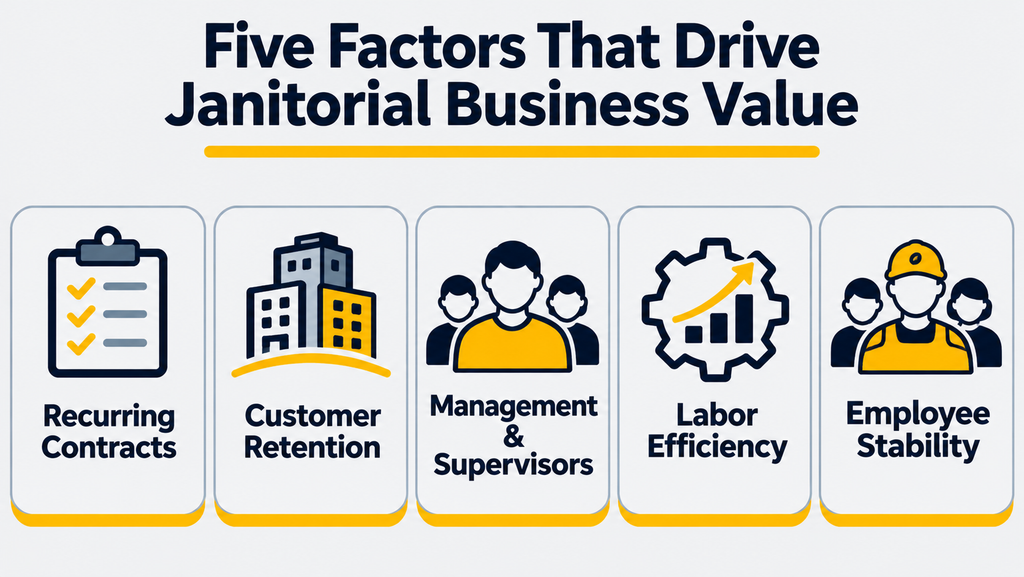
Five Factors That Drive Janitorial Business Value
Several characteristics can significantly influence buyer interest and valuation.
Understanding these factors can help you identify opportunities to strengthen your company before selling.
1. Recurring Commercial Cleaning Contracts
Recurring revenue is often one of the most attractive characteristics of a janitorial business.
Commercial cleaning agreements can provide predictable monthly billing and established customer relationships.
Customers may include office buildings, medical facilities, schools, industrial properties, retail centers, and other commercial facilities.
However, buyers don’t simply count the number of contracts.
They examine:
- Contract duration and renewal provisions
- Customer retention history
- Termination and cancellation rights
- Contract profitability
- Pricing adjustment provisions
- Transferability upon a sale
- Customer concentration
A company with $5 million in annual recurring revenue isn’t necessarily worth more than a smaller competitor if its contracts have weak margins, high turnover, or unusually short cancellation provisions.
The most attractive recurring revenue is profitable, dependable, and likely to continue under new ownership.
2. Customer Diversification and Retention
Customer concentration is an important consideration in janitorial business valuations.
Consider a hypothetical cleaning company generating 35% of its revenue from one property management group.
Even if that customer relationship has existed for many years, a buyer may be concerned about the potential consequences of losing it.
By comparison, a company with diversified commercial accounts and consistently high retention may present less operating risk.
Buyers will also examine whether customer relationships are managed by the company or depend primarily on the seller.
A strong account management structure can help protect customer relationships during a transition.
3. Experienced Supervisors and Management
Janitorial businesses are labor-intensive operations that require consistent supervision and quality control.
Experienced area managers, account supervisors, operations managers, and administrative personnel play an important role in maintaining service standards.
Buyers want to understand how the business handles scheduling, employee absences, customer complaints, inspections, and staffing changes.
If the owner personally manages most customer relationships and operational problems, a buyer may need to recruit additional management or negotiate a longer transition.
A company with capable supervisors and established procedures may be easier to transfer.
A strong management team doesn’t just make your business easier to operate. It can make the company easier to sell.
4. Labor Efficiency and Consistent Profitability
Labor is typically one of the largest expenses in a janitorial business.
Small changes in wages, overtime, scheduling, or staffing requirements can significantly affect profitability.
Buyers examine gross margins, labor costs by account, overtime, turnover, and contract pricing.
For example, consider two hypothetical cleaning companies with identical revenue.
Company A has organized scheduling, accurate account-level profitability reports, and pricing that reflects its labor costs.
Company B has several underpriced contracts, excessive overtime, and limited visibility into its margins.
Even with similar reported earnings today, buyers may have greater confidence in Company A’s ability to sustain profitability.
Reliable financial reporting and accurate job costing are important parts of demonstrating earnings quality.
5. Employee Retention and Operating Systems
A janitorial company’s workforce is central to its success.
Buyers want to understand employee turnover, supervisor coverage, training procedures, and how the company maintains service quality.
High turnover can increase recruiting and training costs, reduce service consistency, and contribute to customer dissatisfaction.
Established operating procedures can help reduce these risks.
Buyers may evaluate employee onboarding, scheduling systems, quality inspections, customer communications, and procedures for responding to service problems.
A company with reliable employees and documented systems may present a more attractive acquisition opportunity.
Understand what drives your janitorial company’s value
Our janitorial business advisory services help owners understand how buyers evaluate recurring contracts, customer relationships, operating risks, and sustainable earnings.
Explore Our Janitorial Business Valuation & Sale Services
Why Customer Contracts Matter So Much When Selling a Janitorial Business
Recurring contracts are often central to the value of a commercial cleaning company.
But not all contracts offer the same level of security.
Some agreements renew automatically and have longstanding customer relationships.
Others allow cancellation with relatively short notice.
Some contracts also require customer consent before they can be assigned to a buyer.
These differences can have a meaningful impact on a transaction.
Buyers may ask several questions:
How long have customers been with the company?
A longstanding relationship can support confidence in revenue continuity, particularly when retention has remained strong through previous contract renewals.
How easily can customers terminate their agreements?
Short cancellation provisions can introduce uncertainty even when a business has a large base of recurring customers.
Can contracts continue after the ownership transition?
Some agreements may require consent or contain provisions triggered by changes in ownership or control.
Are the contracts profitable?
A large contract can generate substantial revenue while producing disappointing margins.
Does the customer relationship depend on the owner?
If the seller personally maintains every important account, a buyer may be concerned about customer retention after closing.
Understanding these issues before going to market can help identify potential buyer concerns and reduce surprises during due diligence.
How Does Customer Concentration Affect Janitorial Business Value?
Many commercial cleaning businesses develop strong relationships with property management companies, facility operators, and institutional customers.
These relationships can generate significant recurring revenue.
However, they can also create customer concentration.
For example, a company may clean several separate office buildings for one property management group.
Although the company services multiple locations, the revenue may ultimately depend on one customer relationship or decision-maker.
If that relationship ends, the business could lose several contracts simultaneously.
Buyers will evaluate how concentrated revenue is by customer, ownership group, and decision-making authority.
They may also examine historical retention and whether accounts can be transferred successfully.
High concentration doesn’t automatically make a company unsellable.
However, it may affect valuation, financing, purchase agreement terms, or buyer willingness to proceed.
For more information, read What Is Customer Concentration Risk and How Does It Affect Your Sale Price?.
Who Buys Janitorial and Commercial Cleaning Businesses?
Several types of buyers may be interested in acquiring a well-established cleaning company.
Strategic Buyers
Existing janitorial and facility maintenance companies may acquire another business to expand geographically, add customers, increase workforce capacity, or enter new markets.
A strategic buyer may recognize value in your recurring contracts, supervisors, employees, equipment, and operating infrastructure.
They may also have existing management systems that allow them to integrate your company into a larger organization.
Private Equity-Backed Buyers
Private equity-backed facility services and commercial maintenance groups may seek acquisitions to expand their operations.
Some buyers look for larger businesses with independent management teams and established operating infrastructure.
Others pursue smaller add-on acquisitions that complement an existing platform.
Recurring revenue and customer retention can make janitorial businesses attractive, but buyers still evaluate labor costs, margins, management requirements, and acquisition risks.
Private equity interest doesn’t automatically guarantee a premium valuation.
Individual Buyers and Industry Operators
Smaller cleaning businesses may appeal to experienced industry professionals and qualified individual buyers.
These buyers may want to purchase an established customer base and operating team rather than starting a company from scratch.
Financing availability, owner involvement, and management continuity may play significant roles in the transaction.
Considering a sale?
Different buyers may value your company for different reasons. Identifying the right buyer group can influence the purchase price, transaction structure, and likelihood of closing.
Schedule a Free, Confidential Consultation
How Do Employee Retention and Labor Compliance Affect a Sale?
Janitorial businesses depend heavily on employees.
Buyers need to understand whether the company can maintain its workforce and deliver consistent service after closing.
Employee turnover, absenteeism, wage increases, and difficulties recruiting qualified personnel may affect profitability and customer relationships.
Buyers may review payroll records, employee classifications, overtime practices, training, workers’ compensation, and applicable labor requirements.
For companies with union employees, collective bargaining agreements and benefit obligations may also require additional due diligence.
Some jurisdictions impose specific worker-retention requirements in certain cleaning-service transitions.
The applicable rules depend on the company’s locations, customers, employees, and transaction structure.
These issues don’t automatically make a business harder to sell.
But buyers want confidence that the company’s labor practices are compliant and that the workforce can be maintained after the transaction.
Organized employment records and established human resources procedures can help reduce uncertainty.
Can You Sell a Janitorial Business If You’re Still Running It Every Day?
Yes.
Many commercial cleaning companies are sold while their owners remain actively involved.
Some owners handle customer relationships, employee scheduling, operations, hiring, or service quality.
This isn’t unusual.
However, buyers will evaluate how much the company depends on the owner and what resources are needed after the transition.
If you’re personally managing every major customer relationship and supervising daily cleaning operations, a buyer may need additional personnel or a longer transition period.
This can affect valuation and deal structure.
If selling is several years away, developing supervisors, account managers, and administrative personnel can help strengthen your business.
But your janitorial company doesn’t need to operate perfectly without you to be a viable acquisition opportunity.
The important consideration is whether the buyer has a realistic plan for managing the business after closing.
What If My Janitorial Business Isn’t a Perfect Acquisition Opportunity?
Not every janitorial company has long-term contracts, consistent profit margins, diversified customers, low employee turnover, and an independent management team.
Maybe you have a few large customers.
Perhaps labor expenses have increased faster than contract pricing.
You might still be heavily involved in operations.
Or certain accounts may be generating less profit than they should.
These are legitimate concerns.
They can affect valuation and buyer interest.
But they don’t automatically mean your business cannot be sold.
Some buyers may value your customer relationships, trained workforce, geographic presence, or opportunities to improve operating efficiency.
Others may be interested in integrating your company into an existing facility services platform.
Selling at the very top of the market isn’t realistic for every company.
A solid, financially meaningful exit may still be possible.
The key is understanding your company’s strengths, being realistic about its weaknesses, and identifying buyers whose acquisition goals align with what your company offers.
A successful exit isn’t always about achieving the highest possible valuation multiple. It’s about finding the right outcome for your financial goals and future.
How to Prepare Your Janitorial Business for Sale
Whether you’re considering selling next year or several years from now, there are practical steps you can take to strengthen your company.
1. Organize Your Financial Statements
Prepare at least three years of financial statements and tax returns.
Review owner compensation, nonrecurring expenses, payroll, and legitimate earnings adjustments.
Buyers need to understand the company’s sustainable profitability.
2. Review Your Customer Contracts
Prepare an organized list of commercial cleaning contracts, customer tenure, renewal dates, termination provisions, and monthly billing.
Identify contracts that may be underpriced or create customer concentration risk.
3. Evaluate Account-Level Profitability
Review labor costs, overtime, supply expenses, and gross margins for major accounts.
Look for opportunities to improve pricing, scheduling, and operating efficiency.
4. Strengthen Your Management Team
Develop area supervisors, account managers, and operations personnel capable of handling responsibilities currently managed by the owner.
Document important customer relationships and procedures.
5. Improve Employee Retention
Review hiring, onboarding, training, compensation, supervisor coverage, and employee turnover.
Identify opportunities to improve workforce stability and service quality.
6. Review Operational and Employment Records
Organize employee records, insurance information, quality-control procedures, and other materials buyers may request.
Address potential compliance issues with qualified advisors before beginning the sale process.
7. Obtain a Professional Business Valuation
A valuation can help establish realistic expectations and identify opportunities to improve your company’s value before entering the market.
Thinking about selling in the next one to three years?
A valuation isn’t a commitment to list your company. It’s an opportunity to understand what buyers may pay today and what you can do to strengthen your position.
Request Your Free Janitorial Business Valuation
How Long Does It Take to Sell a Janitorial Business?
Many privately held business sales require approximately six to twelve months, although the actual timeline depends on the company’s size, readiness, buyer requirements, and financing.
A typical sale process includes five stages.
1. Valuation and Preparation
Review the company’s financial performance, customer contracts, labor costs, operations, and likely market value.
2. Confidential Marketing
Identify qualified buyers while protecting sensitive information about your business, employees, and customers.
3. Buyer Qualification and Offers
Evaluate proposed purchase prices, financing, deal terms, and overall buyer fit.
4. Due Diligence
Verify financial statements, customer contracts, employee records, account profitability, and other material information.
5. Closing and Transition
Finalize transaction documents and coordinate the transition of customer relationships, management responsibilities, and business operations.
A structured process can help protect confidentiality, reduce unexpected issues, and improve the likelihood of a successful transaction.
Learn More About the BizSellingExpert Sale Process.
Common Mistakes Janitorial Business Owners Make When Selling
Even successful commercial cleaning companies can encounter challenges during a sale.
Overestimating the value of recurring contracts. Buyers evaluate contract profitability, cancellation provisions, customer retention, and transferability—not just monthly revenue.
Ignoring customer concentration. Heavy reliance on one property management company or major account can increase acquisition risk.
Failing to understand labor costs. Underpriced contracts, overtime, and inefficient staffing can significantly reduce profitability.
Underestimating owner dependence. Buyers need confidence that the business can continue operating after the owner leaves.
Failing to document earnings adjustments. Add-backs should be legitimate, supportable, and clearly explained.
Ignoring employment compliance. Unresolved wage, overtime, classification, or other labor issues may create additional due diligence concerns.
Focusing only on purchase price. Seller financing, earnouts, working capital, taxes, and other transaction terms can significantly affect actual proceeds.
Addressing these issues before going to market can improve buyer confidence and negotiating leverage.
Frequently Asked Questions About Selling a Janitorial Business
How much can I sell my janitorial company for?
Your company’s value depends on sustainable earnings, recurring contracts, customer retention, labor efficiency, management strength, and buyer demand. A company-specific valuation is more reliable than applying a generic multiple.
What EBITDA multiple do janitorial businesses sell for?
There is no universal multiple. Company size, contract stability, profitability, customer concentration, workforce, and owner involvement all influence valuation.
Do recurring cleaning contracts increase business value?
They can. Profitable recurring contracts with strong customer retention may make revenue more predictable and improve buyer confidence. Buyers also examine renewal and termination provisions.
Can I sell my janitorial company if I have customer concentration?
Yes. However, significant dependence on a small number of customers may affect buyer interest, valuation, and deal terms.
How important is my management team?
Very important. Experienced supervisors and operations managers can help demonstrate that the business will continue functioning after ownership changes.
Will employees know I’m selling?
A professionally managed sale process typically emphasizes confidentiality. Buyer screening, confidentiality agreements, and staged disclosure of sensitive information help manage unnecessary exposure, although certain employees may eventually need to participate.
Can I sell a janitorial company with high employee turnover?
Yes, but turnover may influence buyer confidence and expected future labor costs. Demonstrating reliable operations and realistic staffing plans can help address these concerns.
Should I obtain a valuation before selling?
Yes. A preliminary valuation can help establish realistic expectations, identify potential buyer concerns, and reveal opportunities to strengthen your company before going to market.
Ready to Explore Selling Your Janitorial Business?
You’ve spent years building your company.
Before deciding what comes next, it makes sense to understand what you’ve created and what buyers may be willing to pay.
At BizSellingExpert, we specialize in helping owners of established service and contracting businesses understand their market value, prepare for a sale, and connect with qualified buyers.
Our team at SD Business Advisors has completed more than 850 business transactions since 2007.
We understand that every business—and every owner’s goals—are different.
Some owners are ready to retire.
Others are considering an unsolicited offer or planning to reduce their involvement.
And many simply want to understand their options before making a decision.
Every successful exit starts with understanding your company’s value.
We’ll discuss your financial performance, customer contracts, management, operating structure, and the factors buyers are likely to consider.
You’ll gain a clearer understanding of what supports your company’s market value, what concerns buyers may raise, and what you can do to prepare for a successful exit.
Get Your Free, Confidential Business Valuation
Schedule a Confidential Consultation
This article provides general educational information and does not constitute legal, accounting, tax, employment, or appraisal advice. Illustrative valuation calculations do not represent guaranteed sale prices or transaction outcomes.