

How to Sell a Fire Protection Business: Valuation, Buyers & Exit Strategy
You’ve spent years building your fire protection company.
You’ve developed customer relationships, trained skilled technicians, invested in equipment, and built a reputation for protecting buildings and the people who occupy them.
But when you’re thinking about retirement, pursuing a new opportunity, or simply reducing your involvement, an important question comes up:
What is my fire protection business worth, and what does it take to sell it successfully?
Fire protection companies can be attractive acquisition opportunities because of their specialized capabilities, established customer relationships, and recurring inspection and maintenance requirements.
However, not every fire protection company is valued equally.
Buyers look beyond annual revenue. They examine the quality of recurring inspection contracts, service profitability, technician qualifications, licensing, management strength, customer concentration, and the company’s ability to continue operating after the owner leaves.
Understanding these factors can help you establish realistic expectations and prepare for a successful exit.
How Much Is a Fire Protection Business Worth?
Most established, profitable fire protection companies are valued primarily on their ability to generate sustainable earnings.
For larger businesses, buyers typically evaluate adjusted EBITDA, or earnings before interest, taxes, depreciation, and amortization, with appropriate adjustments for legitimate nonrecurring expenses and other normalizations.
Smaller owner-operated businesses may instead be evaluated using Seller’s Discretionary Earnings (SDE).
A common starting point is:
Enterprise Value = Adjusted EBITDA × Valuation Multiple
Consider a hypothetical fire protection company generating $1 million in adjusted EBITDA.
| Illustrative EBITDA Multiple | Enterprise Value |
|---|---|
| 3.0× | $3,000,000 |
| 4.0× | $4,000,000 |
| 5.0× | $5,000,000 |
| 6.0× | $6,000,000 |
These figures illustrate the calculation only. They are not current fire protection industry valuation benchmarks or estimates of what a particular company would sell for.
Actual valuation multiples depend on several factors, including:
- Recurring inspection, testing, and maintenance revenue
- Historical profitability and earnings consistency
- Service versus installation revenue
- Customer concentration and retention
- Technician qualifications and certifications
- Management independence
- Licensing and regulatory requirements
- Project backlog and execution risk
- Opportunities for future growth
Two fire protection businesses with identical earnings can receive substantially different offers.
For example, a company with a dependable inspection portfolio, qualified technicians, and experienced management may be valued differently from a contractor that depends heavily on large installation projects and its owner’s personal involvement.
Buyers aren’t simply purchasing your historical earnings. They’re purchasing confidence that your company can continue producing those earnings after you leave.
What could your fire protection company sell for?
A professional valuation can help establish realistic expectations and identify the factors that support or limit your company’s market value.
Get Your Free, Confidential Business Valuation
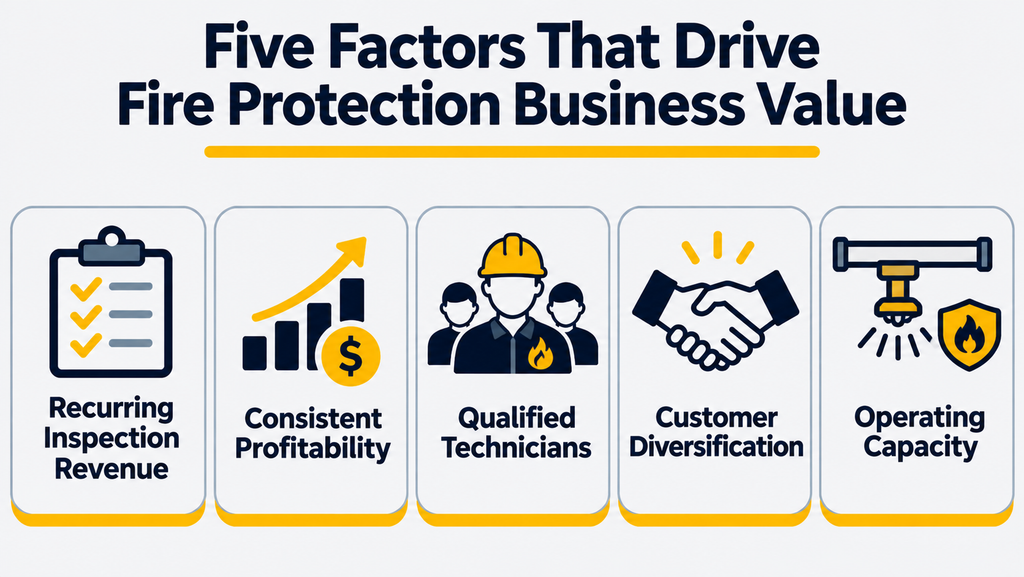
Five Factors That Drive Fire Protection Business Value
Buyers evaluate several characteristics when determining what they’re willing to pay for a fire protection company.
Understanding these value drivers can help you identify opportunities to strengthen the business before selling.
1. Recurring Inspection and Maintenance Revenue
Recurring inspection, testing, and maintenance revenue is often one of the most attractive characteristics of a fire protection business.
Fire protection systems require ongoing inspections, testing, and maintenance under applicable codes, standards, and local requirements.
This creates opportunities for repeat service relationships with building owners, property managers, facility operators, and institutional customers.
A company with established inspection agreements may benefit from predictable customer contact and recurring service demand.
However, buyers don’t simply count the number of agreements.
They examine:
- Annual inspection and testing revenue
- Customer retention and renewal history
- Contract terms and termination provisions
- Profitability of inspection work
- Opportunities for repair and deficiency correction
- Customer concentration
- Whether agreements can continue after ownership changes
The most valuable recurring revenue is profitable, dependable, and likely to continue under new ownership.
2. Consistent Profitability
Buyers want to understand whether the company’s earnings are sustainable.
Fire protection businesses may generate revenue from inspections, repairs, maintenance, system installations, and new construction projects.
Each activity can have different margins, labor requirements, and working capital demands.
A company producing consistent profits from recurring service operations may be easier to evaluate than one with unpredictable project earnings.
That doesn’t mean installation-focused companies aren’t valuable.
An established fire sprinkler contractor with reliable estimating, profitable backlog, and experienced project managers can also be an attractive acquisition.
The important consideration is whether buyers can confidently assess future cash flow.
3. Qualified Technicians and Management
Fire protection businesses depend on specialized personnel.
Experienced sprinkler fitters, inspectors, technicians, estimators, project managers, and supervisors provide capabilities that can take years to develop.
Buyers may evaluate technical qualifications, certifications, employee retention, and the company’s ability to recruit and train personnel.
They also examine owner dependence.
If the owner is the primary estimator, license qualifier, service manager, and customer relationship contact, a buyer may need to add management or negotiate an extended transition.
A business with experienced leadership and qualified employees may present less acquisition risk.
4. Customer Diversification and Retention
Fire protection companies often develop longstanding relationships with property managers, general contractors, municipalities, schools, hospitals, and commercial facility operators.
These relationships can generate valuable recurring business.
However, excessive dependence on one customer or general contractor can increase risk.
For example, a company generating 40% of its revenue from one property management group may face significant exposure if that relationship ends.
Buyers want to understand how revenue is distributed among customers, how long relationships have existed, and whether those relationships will continue after the sale.
A diversified customer base and strong retention history can improve buyer confidence.
5. Licensing, Operating Capacity, and Growth
A fire protection company’s technical capabilities and operating infrastructure can contribute to its acquisition value.
Buyers may evaluate licensing, technician qualifications, estimating systems, inspection documentation, equipment, service coverage, and the ability to complete additional work.
They may also recognize opportunities to expand services or enter new geographic markets.
However, these opportunities are valuable only when the company has the resources and qualifications needed to execute them.
A company with dependable service revenue, qualified employees, established management, and the ability to grow profitably may offer more than its current earnings alone suggest.
Understand what drives your company’s value
Our fire protection business advisory services help owners evaluate the factors buyers consider and identify opportunities to improve market value before a sale.
Explore Our Fire Protection Business Valuation & Sale Services
Why Inspection, Testing, and Maintenance Revenue Matters to Buyers
For many fire protection businesses, inspection, testing, and maintenance—often called ITM—represent an important source of revenue.
Unlike one-time installation projects, inspection services may bring customers back on recurring schedules.
That recurring contact can also create opportunities for repairs, deficiency corrections, equipment replacements, and system upgrades.
Consider two hypothetical fire protection companies.
Company A generates most of its revenue from large fire sprinkler installation projects.
Company B generates a substantial portion of its revenue from established inspection agreements and ongoing repair work.
Both may be profitable businesses.
However, Company B may offer more predictable customer activity, while Company A may be more dependent on winning and completing new projects.
Buyers will evaluate the relative profitability, growth potential, capital requirements, and risk of each model.
The existence of recurring inspections doesn’t automatically guarantee a premium valuation.
Contract quality, customer retention, pricing, staffing, and service margins still matter.
Fire Sprinkler Installation vs. Fire Protection Service: Which Is More Valuable?
Neither business model automatically commands a higher valuation.
Fire Sprinkler Installation Contractors
Installation-focused companies may have established relationships with general contractors, developers, and commercial property owners.
They may possess specialized design capabilities, experienced project managers, and the workforce required to execute significant projects.
Buyers often review:
- Contract backlog
- Job profitability
- Work-in-progress schedules
- Customer concentration
- Change orders
- Bonding and insurance
- Working capital requirements
A strong installation contractor can be an attractive strategic acquisition, particularly when its capabilities complement an existing buyer’s operations.
Inspection and Service Companies
Inspection and service businesses may offer recurring customer relationships and opportunities for repair work.
Buyers often focus on retention, service margins, technician productivity, route efficiency, and the relationship between inspection visits and follow-on repairs.
Companies Offering Both
A company combining profitable installation work with an established inspection and service division may offer buyers a diversified revenue mix.
For example, an installation project may lead to a longstanding inspection relationship.
Similarly, an inspection customer may eventually need significant system repairs or replacements.
The key is demonstrating that each division contributes sustainable earnings and operates efficiently.
How Does Project Backlog Affect Fire Protection Business Value?
For contractors performing fire sprinkler installations or major system upgrades, backlog can be an important consideration.
Backlog generally represents contracted work that remains to be completed.
It can provide visibility into future revenue, but buyers also want to understand whether that work will be profitable.
A contractor may have substantial remaining backlog but face challenges involving labor availability, project delays, material costs, or disputed change orders.
Buyers evaluate remaining contract value alongside estimated costs to complete and anticipated gross profit.
Reliable job costing and work-in-progress reporting are particularly important.
Backlog supports valuation when buyers believe it represents profitable work that the company can execute successfully.
Who Buys Fire Protection Companies?
Several buyer groups may be interested in acquiring an established fire protection company.
Strategic Buyers
Existing fire protection, mechanical contracting, building services, and life-safety companies may pursue acquisitions to expand geographically or add capabilities.
A strategic buyer may value your customer relationships, technicians, service coverage, licensing, and management infrastructure.
An established company may also offer a faster way to enter a new geographic market than developing an operation from scratch.
Private Equity-Backed Buyers
Fire and life-safety companies have attracted acquisition interest from larger platforms seeking to expand their operations.
Some buyers seek businesses with strong management and the ability to serve as regional platforms.
Others pursue smaller add-on acquisitions that complement existing operations.
Recurring inspection and service revenue may be attractive, but buyers still evaluate earnings quality, customer concentration, staffing, integration requirements, and growth opportunities.
Private equity interest does not automatically guarantee a premium purchase price.
Individual Buyers and Industry Operators
Smaller fire protection businesses may appeal to experienced contractors, industry professionals, or qualified individual buyers.
These transactions may involve acquisition financing and additional attention to licensing, management continuity, and the seller’s transition period.
Already considering a sale?
Different buyers may value your company for different reasons. Finding the right buyer can affect not only purchase price but also transaction terms and the likelihood of closing.
Schedule a Confidential Consultation to Discuss Your Options
How Do Licensing and Certifications Affect the Sale of a Fire Protection Business?
Licensing and technician qualifications deserve special attention during a fire protection business sale.
In California, a C-16 Fire Protection Contractor license covers the layout, fabrication, and installation of fire protection systems within the classification’s scope. Electrical alarm systems are excluded from that classification.
Depending on the business’s activities, other licenses, registrations, and personnel certifications may apply.
For certain commercial and multifamily water-based fire protection work, California also has specific fire sprinkler fitter certification and registration requirements.
Buyers will want to understand how the company will maintain all necessary qualifications after ownership changes.
If the owner currently serves as the qualifying individual, the transition may require planning to ensure that the business can continue operating legally.
These issues can affect transaction structure, management retention, and closing requirements.
For additional information, review the California Contractors State License Board’s C-16 Fire Protection classification.
Licensing continuity should be addressed before accepting an offer, not treated as an issue to resolve at the closing table.
Can You Sell Your Fire Protection Business If You’re Still Running It Every Day?
Yes.
Many fire protection businesses are sold while their owners remain actively involved in daily operations.
You may still handle estimating, major customer relationships, service management, licensing, or project oversight.
This isn’t unusual for privately held contracting companies.
However, buyers need to understand what responsibilities will need to be transferred.
A buyer with existing management may be able to integrate your business into its operations.
Another buyer may need to recruit additional personnel or require a longer seller transition.
These considerations can affect valuation and deal structure.
If selling is still several years away, strengthening management and delegating key responsibilities can improve your options.
But your business doesn’t need to operate perfectly without you to be a viable acquisition opportunity.
What If My Fire Protection Company Isn’t a Perfect Acquisition Opportunity?
Not every fire protection company has a large recurring inspection portfolio, consistent year-over-year earnings, diversified customers, and an experienced management team.
Perhaps your revenue depends heavily on construction projects.
Maybe you have customer concentration.
Your management team may still be developing.
Or you may personally hold qualifications and customer relationships that are essential to the operation.
These are legitimate buyer concerns.
They can influence valuation and transaction terms.
But they don’t automatically make your company unsellable.
Some buyers may value your technicians, licensing capabilities, customer relationships, geographic presence, or opportunities to integrate your operations.
Others may see opportunities to improve service profitability or expand recurring inspection revenue.
Selling at the very top of the market isn’t always realistic.
A solid, financially meaningful exit may still be achievable.
The important thing is understanding your company’s strengths, recognizing its challenges, and identifying buyers whose acquisition goals align with what your business offers.
How to Prepare Your Fire Protection Company for Sale
Whether you’re considering selling next year or several years from now, preparation can improve your options.
1. Organize Your Financial Statements
Prepare at least three years of financial statements and tax returns.
Review owner compensation, nonrecurring expenses, service margins, and legitimate earnings adjustments.
Buyers need to understand the company’s sustainable profitability.
2. Separate Revenue by Service Line
Identify revenue and gross profit from inspections, testing, maintenance, repairs, system installations, and other activities.
Understanding this revenue mix helps buyers evaluate the quality of your earnings.
3. Review Inspection Contracts and Retention
Organize customer agreements, renewal dates, historical retention, pricing, and contract profitability.
Identify concentration issues and any contracts requiring consent for assignment or ownership changes.
4. Strengthen Management and Employee Retention
Evaluate the responsibilities of technicians, service managers, estimators, project managers, and administrative employees.
Document important procedures and identify roles that depend heavily on the owner.
5. Review Licensing and Certifications
Confirm the company’s licenses, registrations, employee certifications, and qualifying individual arrangements.
Develop a workable plan for maintaining required qualifications after a sale.
6. Update Project Backlog and Job Costing
For companies performing significant installation work, organize backlog reports, job profitability, and work-in-progress schedules.
Identify outstanding change orders and potential project risks.
7. Obtain a Professional Business Valuation
A valuation can establish realistic expectations and identify opportunities to improve your company’s value.
Some improvements can be made relatively quickly. Others may require longer-term planning.
Thinking about selling in the next one to three years?
A valuation isn’t a commitment to list your company.
It’s an opportunity to understand what buyers may pay today, what drives your market value, and what you can do to strengthen your position before selling.
Request Your Free Fire Protection Business Valuation
How Long Does It Take to Sell a Fire Protection Business?
Many privately held business sales take approximately six to twelve months, although the actual timeline depends on company size, financial readiness, buyer requirements, financing, and transaction complexity.
A typical process involves five stages.
1. Valuation and Preparation
Review financial performance, recurring revenue, licensing, management, and likely market value.
2. Confidential Marketing
Identify qualified buyers while protecting sensitive financial, customer, and employee information.
3. Buyer Qualification and Offers
Evaluate purchase prices, financing, proposed terms, and buyer capabilities.
4. Due Diligence
Verify financial records, inspection contracts, project backlog, employee qualifications, licensing, and other material information.
5. Closing and Transition
Finalize agreements and coordinate the transfer of management responsibilities, customer relationships, and ownership.
An organized sale process can help reduce surprises and maintain momentum through closing.
Learn More About the BizSellingExpert Sale Process
Common Mistakes Fire Protection Business Owners Make When Selling
Even successful fire protection companies can encounter challenges during a sale.
Assuming all recurring revenue is equally valuable. Buyers examine profitability, renewal history, cancellation provisions, and customer retention.
Overvaluing project backlog. Remaining contracted work creates confidence only when buyers believe it can be completed profitably.
Ignoring licensing continuity. A buyer needs a realistic plan to maintain the qualifications required to operate the business.
Failing to document financial adjustments. Add-backs should be legitimate, supportable, and clearly explained.
Underestimating owner dependence. Buyers want to know whether key responsibilities can be transferred successfully.
Waiting too long to prepare. Owners who begin planning before they urgently need to sell generally have greater flexibility.
Focusing exclusively on purchase price. Financing, working capital, earnouts, seller notes, taxes, and transition obligations can significantly affect the ultimate outcome.
Addressing these issues early can help improve buyer confidence and negotiating leverage.
Frequently Asked Questions About Selling a Fire Protection Business
How much can I sell my fire protection company for?
Your company’s value depends on adjusted earnings, recurring inspection revenue, customer retention, management strength, workforce qualifications, licensing, project exposure, and buyer demand. A company-specific valuation offers a more useful starting point than a generic industry multiple.
What EBITDA multiple do fire protection companies sell for?
There is no universal multiple. Company size, profitability, recurring revenue, management, operating risks, and buyer demand can all influence valuation.
Do inspection contracts increase the value of a fire protection business?
They can. Profitable inspection agreements with strong retention may make revenue more predictable and create opportunities for follow-on repair work.
Can I sell my fire sprinkler company if I’m the license holder?
Yes, but licensing continuity and qualifying individual requirements must be addressed in accordance with applicable laws and the transaction structure.
Are installation contractors less valuable than inspection companies?
Not necessarily. Installation contractors with strong management, profitable backlog, and specialized capabilities can attract significant buyer interest. The two business models have different risk profiles.
Can I sell my company if I’m still running it every day?
Yes. However, buyers will evaluate your responsibilities and how the company can continue operating after your departure.
Can I sell my fire protection business confidentially?
Yes. A structured process can involve buyer screening, confidentiality agreements, and staged disclosure of sensitive information.
Should I get a valuation before approaching buyers?
Yes. A preliminary valuation can help establish realistic expectations, identify potential concerns, and provide a framework for evaluating offers.
Ready to Explore Selling Your Fire Protection Business?
You’ve spent years building your company.
Before making decisions about your future, it makes sense to understand what you’ve created and what qualified buyers may be willing to pay.
At BizSellingExpert, we specialize in helping owners of established service and contracting businesses understand their market value, prepare for a sale, and connect with qualified buyers.
Our team at SD Business Advisors has completed more than 850 business transactions since 2007.
We understand that every company—and every owner’s goals—are different.
Some owners are ready to retire.
Others are considering an unsolicited offer.
Many simply want to understand their options before committing to a decision.
A successful exit starts with knowing what your company is worth and understanding what buyers will value.
We’ll discuss your financial performance, service mix, customer relationships, management structure, and the factors likely to influence buyer interest.
You’ll gain a clearer understanding of what supports your company’s market value, what concerns buyers may raise, and how to prepare for a successful exit.
Get Your Free, Confidential Business Valuation
Schedule a Confidential Consultation
This article is intended for general educational purposes and does not constitute legal, accounting, tax, licensing, regulatory, or appraisal advice. Actual valuations and transaction outcomes depend on company-specific circumstances and market conditions.