

How to Sell a Landscaping Business: Valuation, Buyers & Exit Strategy
You’ve spent years building your landscaping company.
You’ve developed customer relationships, assembled crews, purchased equipment, and established an operation that keeps properties maintained and customers satisfied.
But when it’s time to retire, pursue a new opportunity, or simply reduce your involvement, an important question comes up:
What is my landscaping business worth, and how do I get the best possible outcome when it’s time to sell?
Landscaping companies can be attractive acquisition opportunities, particularly when they have established maintenance contracts, experienced management, efficient operations, and consistent profitability.
However, not all landscaping companies are valued equally.
Buyers look beyond revenue. They examine the quality of recurring contracts, customer concentration, workforce stability, equipment requirements, operating margins, and the company’s ability to function without the current owner.
Understanding these factors can help you prepare for a sale and make better decisions about your future.
How Much Is a Landscaping Business Worth?
Most established, profitable landscaping companies are valued primarily on their ability to generate sustainable earnings.
For larger commercial landscaping and maintenance businesses, buyers typically evaluate adjusted EBITDA—earnings before interest, taxes, depreciation, and amortization, adjusted for appropriate nonrecurring expenses and other normalizations.
Smaller owner-operated landscaping companies may instead be evaluated using Seller’s Discretionary Earnings (SDE).
A common starting point is:
Enterprise Value = Adjusted EBITDA × Valuation Multiple
Consider a hypothetical landscaping company generating $1 million in adjusted EBITDA.
| Illustrative EBITDA Multiple | Estimated Enterprise Value |
|---|---|
| 3.0× | $3,000,000 |
| 4.0× | $4,000,000 |
| 5.0× | $5,000,000 |
| 6.0× | $6,000,000 |
These figures are illustrative calculations, not current industry valuation benchmarks or an estimate of what a specific landscaping company will sell for.
The actual multiple depends on the company’s financial performance, recurring revenue, customer relationships, workforce, management structure, growth potential, and operating risks.
Two landscaping businesses generating identical earnings may receive significantly different offers.
For example, a commercial landscaping company with long-term maintenance relationships, strong customer retention, and experienced management may command a different valuation from a company heavily dependent on seasonal installation projects or its owner’s personal involvement.
The key isn’t just how much your landscaping company earns. It’s how confidently buyers believe those earnings will continue after you leave.
For more information about earnings-based valuation, read our guide to how buyers value service businesses.
What could your landscaping business sell for?
A professional valuation can help establish a realistic market value and identify factors that may increase or decrease buyer interest.
Get Your Free, Confidential Business Valuation
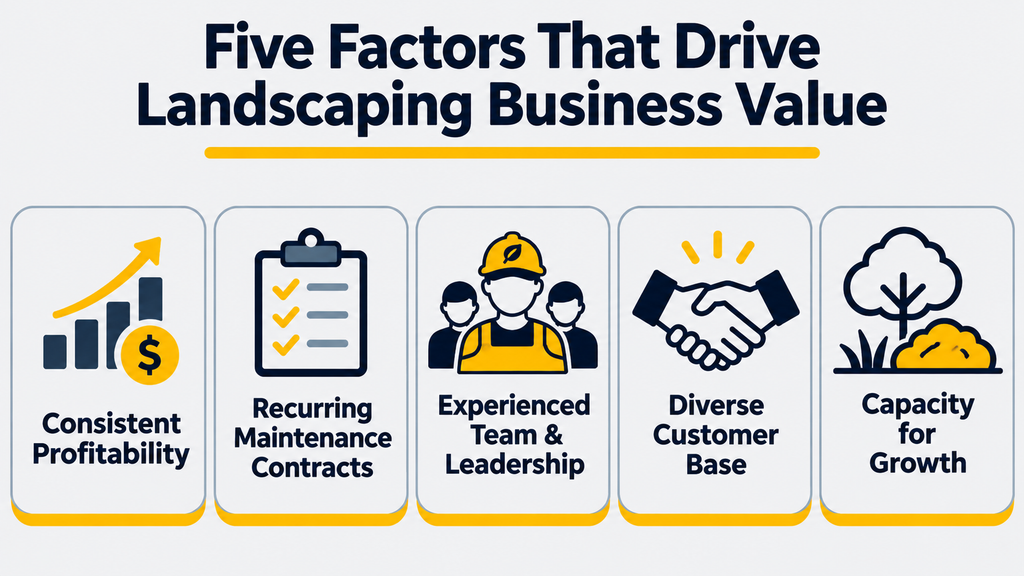
Five Factors That Drive Landscaping Business Value
Buyers evaluate several characteristics when determining how much to offer for a landscaping company.
Understanding these value drivers can help you identify opportunities to strengthen your business before selling.
1. Recurring Maintenance Revenue
Recurring maintenance revenue is often one of the most attractive characteristics of a landscaping company.
Commercial landscape maintenance contracts can provide predictable revenue, established customer relationships, and visibility into future earnings.
Customers may include homeowners associations, commercial property managers, corporate campuses, municipalities, and other institutional clients.
However, buyers don’t simply count the number of maintenance contracts.
They evaluate:
- Contract duration and renewal terms
- Historical customer retention
- Profitability by contract
- Price adjustment provisions
- Contract assignability
- Customer concentration
- Labor and equipment requirements
A large maintenance portfolio isn’t necessarily valuable if contracts are underpriced or unprofitable.
The most attractive recurring revenue is profitable, dependable, and likely to continue after ownership changes.
2. Customer Diversification and Retention
Customer concentration can significantly influence landscaping business valuations.
Consider a hypothetical landscaping company generating 40% of its revenue from a single property management group.
Even if that relationship has existed for years, a buyer may view the company as vulnerable to losing a substantial portion of its earnings.
By comparison, a company with a diversified customer base and strong retention history may present less acquisition risk.
Buyers often want to understand how contracts are awarded, whether customer relationships depend on the owner, and what happens when agreements come up for renewal.
Longstanding customer relationships can be valuable, but diversified relationships may be even more important.
3. Experienced Management and Workforce
A landscaping company’s employees are central to its operations.
Experienced supervisors, account managers, crew leaders, irrigation technicians, estimators, and operations managers help maintain service quality and customer relationships.
Buyers evaluate the company’s ability to recruit, retain, and manage its workforce.
They also examine how much responsibility rests with the owner.
If the owner personally manages every major customer relationship, handles scheduling, estimates projects, and oversees daily crew operations, a buyer may face additional transition expenses.
A company with an experienced management team and established operating procedures may be easier to transfer.
For larger commercial landscaping businesses, the strength of the management team can be an important part of the company’s value.
4. Operating Efficiency and Route Density
Landscaping is an operationally intensive business.
Labor, fuel, equipment maintenance, travel time, and scheduling all influence profitability.
One characteristic buyers may examine is route density—how efficiently a company can service customers within its geographic footprint.
A maintenance company with numerous customers located close together may operate more efficiently than one with crews traveling long distances between properties.
Buyers also evaluate equipment utilization, scheduling systems, crew productivity, and the ability to manage multiple service locations.
Efficient operations can support stronger margins and create opportunities to grow without proportionally increasing overhead.
5. Consistent Profitability and Cash Flow
Revenue growth is important, but buyers ultimately focus on sustainable financial performance.
They review historical gross margins, labor expenses, equipment costs, administrative overhead, and adjusted earnings.
Landscaping companies may experience seasonal fluctuations, changing labor costs, weather-related disruptions, and uneven installation revenue.
Buyers want to understand these trends and determine whether the company’s earnings are repeatable.
Accurate financial reporting helps establish confidence in the company’s performance.
A landscaping company with reliable earnings, documented operating systems, and strong customer relationships may be more valuable than a larger company with less predictable profits.
Find out how your landscaping company measures up
Our landscaping business sale advisory services focus on understanding the factors buyers value and identifying opportunities to improve your company’s market position.
Explore Our Landscaping Business Valuation & Sale Services
Is Commercial Landscaping More Valuable Than Residential Landscaping?
Not necessarily.
Commercial and residential landscaping companies have different operating characteristics and may appeal to different buyers.
Commercial Landscape Maintenance Companies
Commercial maintenance businesses may benefit from established service contracts, recurring revenue, and relationships with property managers, HOAs, municipalities, and businesses.
Buyers may value the ability to forecast revenue and manage recurring service operations.
However, they will also examine contract retention, competitive bidding, labor requirements, and concentration among large property management accounts.
Residential Landscaping Companies
Residential landscaping businesses may benefit from a broad customer base, repeat maintenance work, strong local reputations, and opportunities for additional services.
Buyers often evaluate customer retention, route efficiency, pricing, marketing effectiveness, and owner involvement.
Landscape Design and Installation Companies
Design and installation businesses may generate meaningful earnings from construction projects, outdoor living improvements, irrigation installations, and other specialty services.
These companies may appeal to buyers seeking specialized capabilities and experienced crews.
However, project-driven revenue can be less predictable than recurring maintenance revenue.
Buyers will evaluate project backlog, margins, estimating capabilities, and the company’s ability to maintain a consistent pipeline.
Companies Offering Both Maintenance and Installation
A business combining recurring maintenance with profitable enhancement or installation services may offer attractive opportunities.
Maintenance relationships can create additional opportunities for irrigation work, landscape renovations, seasonal enhancements, and other services.
The important factor is whether each service line contributes sustainable earnings and supports the company’s overall operating model.
Why Landscape Maintenance Contracts Matter to Buyers
For many landscaping companies, maintenance contracts represent a significant portion of their value.
But buyers look closely at the quality of those contracts.
Consider two hypothetical landscaping businesses.
Company A has $5 million in annual revenue, primarily from recurring commercial maintenance agreements with a diverse customer base and strong historical retention.
Company B has the same revenue but depends heavily on a few large installation projects each year.
Even if their current earnings are similar, buyers may view their future revenue visibility differently.
That doesn’t automatically mean Company A is worth more.
A profitable installation contractor with specialized capabilities and a strong project pipeline may still attract substantial buyer interest.
However, the stability and predictability of maintenance revenue can be an important valuation advantage.
Buyers may also review contract renewal history, termination provisions, customer service performance, and whether pricing keeps pace with labor and operating costs.
Maintaining accurate contract records can make a landscaping company easier to evaluate during due diligence.
Who Buys Landscaping Businesses?
Several types of buyers may be interested in acquiring an established landscaping company.
Strategic Buyers
Established landscaping and property maintenance companies may pursue acquisitions to expand geographically, increase customer density, or add service capabilities.
A strategic buyer may value your maintenance contracts, established crews, equipment, management team, and customer relationships.
For example, a landscaping company entering a neighboring market might prefer acquiring an established operation rather than building a new branch from scratch.
Private Equity-Backed Buyers
Private equity-backed landscaping and facility services platforms may acquire companies to expand their operations and geographic footprint.
Some seek larger businesses with established management teams.
Others pursue smaller add-on acquisitions that complement an existing regional platform.
Businesses with recurring maintenance revenue, strong management, reliable earnings, and opportunities for growth may be particularly attractive.
However, private equity involvement does not automatically guarantee a premium valuation.
Individual Buyers and Industry Operators
Smaller landscaping companies may appeal to experienced industry professionals and qualified individual buyers.
These buyers may want to acquire an established customer base, trained employees, equipment, and an existing operating platform.
Financing availability and the seller’s transition requirements can influence the structure of these transactions.
Thinking about selling?
Different buyer groups may value your company for different reasons. Understanding who is most likely to recognize your business’s strengths is an important part of developing the right sale strategy.
Schedule a Free, Confidential Consultation
How Do Equipment and Vehicles Affect Landscaping Business Value?
Landscaping companies often own substantial equipment.
This may include trucks, trailers, mowers, tractors, skid steers, irrigation equipment, and other specialized machinery.
Buyers will evaluate the condition, age, ownership, and maintenance requirements of those assets.
However, it’s important to understand that business valuation methods can already reflect the equipment required to generate the company’s earnings.
You generally cannot assume that the full value of equipment is simply added to an earnings-based enterprise valuation.
Whether specific assets add value separately depends on the valuation method and the agreed transaction structure.
Buyers may also consider equipment loans, lease obligations, deferred maintenance, and future capital expenditures.
A well-maintained fleet with reliable records can reduce uncertainty and help demonstrate operational readiness.
Can You Sell a Landscaping Company If You’re Still Running It Every Day?
Yes.
Many landscaping companies are sold while their owners remain actively involved.
Some owners handle major customer relationships, oversee operations, manage crews, prepare estimates, or personally supervise large projects.
This isn’t unusual.
However, buyers will want to understand how the company operates and what responsibilities will need to be transferred.
If most critical decisions depend on the owner, the buyer may need additional management personnel or a longer transition period.
This can affect valuation and the terms of the transaction.
Developing managers and documenting operating procedures can improve buyer confidence.
But your business doesn’t have to operate perfectly without you to be a viable acquisition opportunity.
The important thing is understanding the transition requirements and selecting a buyer capable of managing them.
What If My Landscaping Business Isn’t a Perfect Acquisition Opportunity?
Not every landscaping company has long-term contracts, consistent year-over-year profits, a complete management team, and minimal owner involvement.
Maybe you have customer concentration.
Perhaps revenue fluctuates because of installation projects or seasonal demand.
You might still be personally responsible for estimating, account management, or daily operations.
These are legitimate concerns, and buyers will consider them.
But they don’t automatically mean your business cannot be sold.
Some buyers value your workforce, equipment, customer relationships, geographic presence, or opportunities to improve operations.
Others may be interested in combining your business with an existing operation to create efficiencies.
Selling at the very top of the market isn’t always realistic. A solid exit may still be possible.
The key is understanding your company’s strengths, being realistic about its weaknesses, and identifying the right acquisition strategy.
A successful exit isn’t always defined by achieving the highest possible valuation multiple.
It’s about achieving an outcome that supports your financial goals and the next stage of your life.
How to Prepare Your Landscaping Business for Sale
Whether you’re planning to sell next year or several years from now, preparation can improve your options.
1. Organize Your Financial Records
Prepare at least three years of financial statements and tax returns.
Review owner compensation, equipment expenses, legitimate add-backs, and historical earnings.
Be prepared to explain the company’s margins and operating trends.
2. Review Your Contract Portfolio
Create an organized summary of maintenance agreements, renewal dates, pricing, customer retention, and profitability.
Identify contracts that may be underpriced or create excessive customer concentration.
3. Evaluate Route Efficiency
Review crew utilization, service territories, travel time, and scheduling.
Identify operational improvements that could increase profitability without sacrificing service quality.
4. Strengthen Management
Develop account managers, field supervisors, and other employees who can assume responsibilities currently handled by the owner.
Document important customer relationships and operating procedures.
5. Review Equipment and Capital Needs
Prepare an updated equipment list identifying major assets, their condition, and outstanding financing obligations.
Review whether significant purchases or replacements may be necessary in the near future.
6. Understand Your Company’s Market Value
A preliminary valuation can help identify what buyers may be willing to pay and the factors influencing that number.
You may discover opportunities to strengthen value before going to market.
Planning to sell in the next one to three years?
Understanding your market value now gives you time to address potential buyer concerns and make improvements before beginning the sale process.
Request Your Free Landscaping Business Valuation
How Long Does It Take to Sell a Landscaping Business?
Many privately held business sales take approximately six to twelve months, although the timeline depends on the company’s size, readiness, buyer interest, and financing.
A typical sale process involves five stages:
1. Valuation and Preparation
Review the company’s financial performance, operations, customer relationships, and market value.
2. Confidential Marketing
Identify qualified buyers while protecting sensitive financial and operational information.
3. Buyer Qualification and Offers
Evaluate purchase prices, financing, transaction terms, and buyer capabilities.
4. Due Diligence
Verify financial records, maintenance contracts, employee information, equipment, customer retention, and other material details.
5. Closing and Transition
Finalize transaction documents and coordinate the transfer of business operations and ownership responsibilities.
An organized sale process can help protect confidentiality, reduce unexpected issues, and improve the likelihood of a successful transaction.
Learn More About the BizSellingExpert Sale Process.
Common Mistakes Landscaping Owners Make When Selling
Even successful landscaping businesses can encounter challenges during a sale.
Overvaluing maintenance contracts. Recurring revenue is attractive, but buyers also evaluate contract profitability, customer retention, and termination provisions.
Ignoring customer concentration. Heavy reliance on one customer or property management group can increase acquisition risk.
Overestimating equipment value. Equipment essential to normal operations may already be reflected in the company’s earnings-based valuation.
Failing to address owner dependence. When customer relationships and daily operations rely heavily on the owner, buyers may require additional transition arrangements.
Waiting too long to prepare. Owners who begin planning before they urgently need to sell generally have more flexibility to improve their position.
Focusing exclusively on purchase price. Financing, working capital, seller notes, earnouts, taxes, and closing certainty all affect the ultimate outcome.
Understanding these potential issues before going to market can help owners approach the sale with more realistic expectations.
Frequently Asked Questions About Selling a Landscaping Business
How much can I sell my landscaping company for?
Your company’s value depends on sustainable earnings, recurring revenue, customer concentration, workforce, management, operating efficiency, equipment requirements, and buyer demand. A company-specific valuation offers a more reliable starting point than a generic industry multiple.
Do maintenance contracts increase the value of a landscaping business?
They can. Profitable maintenance contracts with strong customer retention may make future earnings more predictable. Buyers will also consider contract duration, pricing, concentration, and transferability.
What EBITDA multiple do landscaping companies sell for?
There is no universal multiple. Company size, financial performance, management strength, revenue quality, and operating risks all influence valuation.
Can I sell my landscaping business if I’m still involved every day?
Yes. However, buyers will evaluate the owner’s responsibilities and what resources are required to operate the business after the transition.
Are commercial landscaping businesses more valuable than residential companies?
Not automatically. Commercial maintenance businesses may offer contract-based recurring revenue, while residential businesses can benefit from diversified customers and efficient service routes. Sustainable earnings and operational risks are key considerations for both.
Will a buyer purchase my landscaping equipment?
Equipment required for normal operations is commonly included in business transactions, but the treatment of specific assets depends on the negotiated structure and valuation approach.
Can I sell my landscaping company confidentially?
Yes. A structured process can use anonymous marketing materials, buyer screening, confidentiality agreements, and staged release of sensitive information.
Should I get a valuation before selling?
Yes. A preliminary valuation can help you establish realistic expectations, understand buyer concerns, and identify opportunities to strengthen your company before going to market.
Ready to Explore Selling Your Landscaping Business?
You’ve spent years building your company.
Before deciding what comes next, it makes sense to understand what you’ve created and what buyers may be willing to pay.
At BizSellingExpert, we specialize in representing owners of established service and contracting businesses.
Our team at SD Business Advisors has completed more than 850 business transactions since 2007.
We understand that every company—and every owner’s goals—are different.
Some owners are ready to retire. Others are considering an unsolicited offer, reducing their involvement, or planning an exit several years from now.
And not every company is a perfect acquisition opportunity.
Our role is to help you understand your options, evaluate your company’s market value, and develop a strategy aligned with your goals.
Start With a Free, Confidential Business Valuation.
We’ll discuss your financial performance, customer relationships, operating structure, and the factors buyers are likely to consider.
You’ll gain a clearer understanding of what supports your company’s value, what concerns buyers may raise, and what you can do to prepare for a successful exit.
Get Your Free Business Valuation
Schedule a Confidential Consultation
This article provides general educational information and does not constitute legal, accounting, tax, or appraisal advice. Valuation examples are illustrative, and actual transaction results depend on individual circumstances and market conditions.